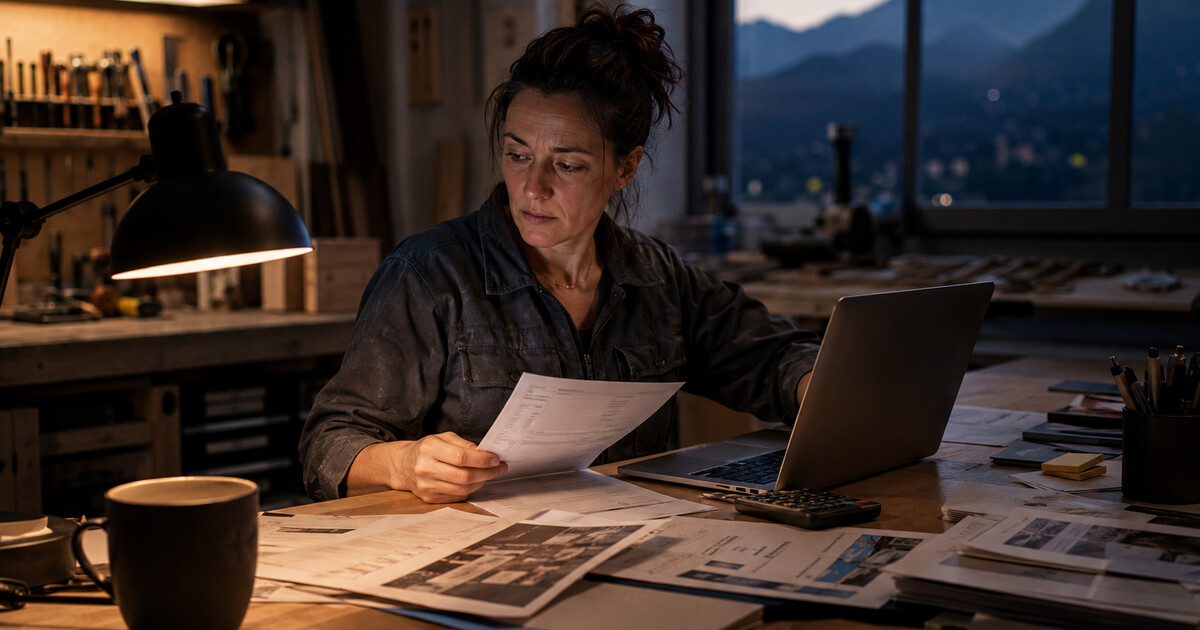
Many craftsmen in Ticino spend their evenings on emails, documents and admin instead of on the trade. Automating recurring communications, documents and deadlines gives those hours back and reduces errors — without changing the tools the team already uses.
Context: digitalisation is cited as a key competitiveness factor for Ticino SMEs in 2026, yet many still work with poorly integrated tools (source: analyses on the digitalisation of Ticino businesses).
Where the craftsman's hours really go
It's not just the site that eats the hours. Admin takes them too: answering the same emails, hunting for a document, rewriting an offer, remembering a deadline, sorting a job's photos. Invisible tasks that, added up, easily come to several hours a week.
The trouble is these tasks always land on the owner and end up outside working hours. That's where errors come from: the message with the wrong name, the forgotten deadline, the document that can't be found. Not through incompetence, but through fatigue and fragmentation.
The good news is that repetitive, predictable tasks are exactly the easiest to automate — without upending anything, working inside the tools you already use.
Communications and documents that handle themselves
A digital assistant can read incoming emails, understand what they're about and prepare a reply ready for approval: appointment confirmations, sending documentation, answers to frequent questions. The owner checks and sends, instead of writing everything from scratch each time.
The same goes for documents: from the job report to the cover letter, from the site sheet to the client note. You start from company templates that the automation fills with the right data, always in the same tidy format. Less copy-paste, fewer wrong versions floating around.
Even filing stops being a nightmare: photos, quotes and documents end up ordered and findable, instead of scattered across phone, email and drawers.
Deadlines and reminders: nothing forgotten again
An automatic reminder system keeps track of the deadlines that today live in the owner's head: client callbacks, appointments, documents to send, cases to close. Everyone gets their notification at the right time, so nothing slips through the cracks.
The value isn't only the time saved: it's the peace of mind of knowing the system keeps count for you. For a Ticino entrepreneur, reducing uncertainty and surprises is often worth as much as saving a few hours.
The best way to see how much you can lighten is on your own processes: in a free audit we map where time is lost and what's worth automating first. And if you want to keep it all up to date over time, the ongoing plans take care of that too.
A day, before and after
Before: the owner finishes the site at six, has dinner, and at eight sits at the computer. He answers eight near-identical emails, hunts for a document across three folders, rewrites a cover letter, jots one deadline on a sticky note and forgets another. He goes to bed late, feeling he never finished.
After: recurring emails already have a reply ready to approve, documents are generated from company templates with one click, deadlines arrive as reminders at the right time. That evening half-hour that used to vanish into admin goes back to family or rest. Over a month, that's whole hours recovered.
The point isn't to work more, but to stop doing by hand what a machine does better. And to do it inside the tools you already use, with nothing new to learn.
That's how we work: a free audit to find where time is lost, then installation, configuration and training. The plans are on the site, in plain terms.
One point is worth stressing: this isn't digitalising for fashion's sake. Many Ticino SMEs have piled up disconnected tools — an app for messages, a sheet for quotes, email for documents — and time is lost exactly in moving between them. The useful work is connecting what's already there, not adding yet another program.
The result we're after is concrete and measurable: fewer evenings at the computer, fewer slip-ups, documents always findable. Benefits you feel from the first week, not abstract promises.
How you start with Dedalix
The first step is to find where your hours really go: we do it by watching a typical week, not with theories. Then we pick the most repetitive task and take it off your plate first, so the saving shows immediately and you're convinced on the ground, not on paper.
From there we proceed in small steps, adding one automation at a time. No revolution, no risk of ending up worse than before: each piece must work and make your life simpler before we move to the next.
Frequently asked questions
Do I have to buy new software?
Almost never. In most cases we work inside the tools you already have — email, Excel, your management system. We add automation, not another thing to learn.
What if every client is different?
All the better. The automation prepares drafts and handles the repetitive part; decisions and special cases stay with you. It removes the mechanical work, not the control.
How long does it take to start?
Automating a single business area is quick to set up: audit, installation, team training and support. Then it can extend to other areas whenever you want.
Is it suitable for a small business?
Yes — in fact, small operations where the owner does everything benefit most, because every freed hour goes straight back to the work that earns.