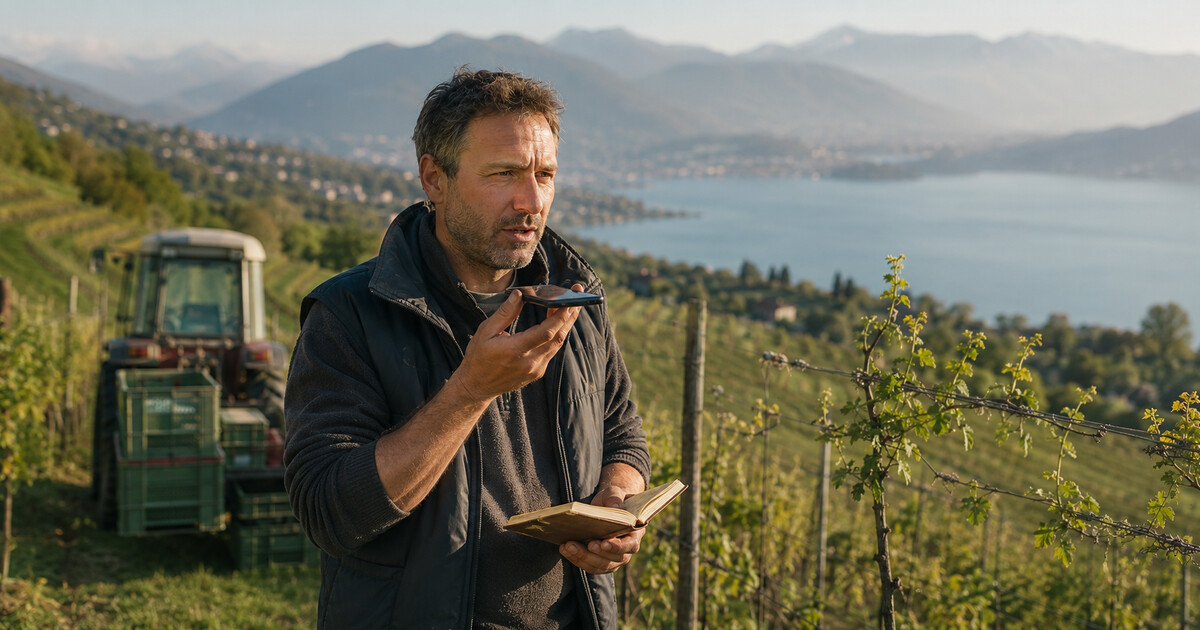
Between records, traceability, notifications and communications, admin work weighs ever more on Ticino farms — and it always falls on the same few people. Automating documents and recurring communications gives back precious hours for work in the fields and reduces the risk of errors and missed deadlines.
Context: in 2026 the harvest was brought forward by the heat and pest pressure from new insects is rising; meanwhile the bureaucratic load reported by Ticino businesses keeps growing (sources: wine sector, Cc-Ti).
Paperwork is every farmer's second job
Anyone who works the land knows that field work comes with a second job of records, forms, traceability and communications. It's a load that grows year by year and often ends up in the evening, taking time and energy from the real work. And one error or missed deadline can cost dearly.
2026 has added pressure: a harvest brought forward by the heat and new pest threats demand attention and speed just when desk time is squeezed to a minimum. Ticino businesses have reported a steady rise in administrative burdens for years.
You can't eliminate paperwork, but you can take the mechanical, repetitive part off the farmer — the part a machine does better and without tiring.
Records and documents that almost fill themselves
An automation can turn a quick note — even a voice note or a photo — into the correct record line, in the required format. Treatments, operations, movements: you jot it down on the spot, the system tidies it and prepares the documents, instead of reconstructing everything at the weekend.
The same goes for recurring documents: communications to suppliers and customers, sheets, summaries. You start from templates the automation fills with the right data, always consistent and findable. Fewer scattered sheets, less risk of not finding a document when you need it.
The concrete value is double: hours given back to productive work and fewer errors exactly where an error costs most — in traceability and deadlines.
Communications and reminders: nothing falls through
Supplier orders, customer notices, reminders for deadlines and obligations: a system can handle them automatically, sending the right communication at the right time and flagging to the owner what needs a decision. What lives today in the farmer's head passes to a system that doesn't forget.
For a family-run farm, where everything falls on a few people, this peace of mind is worth as much as the time saved: fewer surprises and calmer work, knowing obligations are under control.
The starting point is finding where most time is lost: we do it together in a free audit, then we install and configure everything. If you want to keep the system up to date over time, look at the ongoing plans.
From field notebook to records, without re-copying
In peak season, who has time to sit at a desk? The treatment gets jotted on a scrap of paper, the operation is kept in mind, and at the weekend it all has to be reconstructed to fill in the records. That's where dates and details slip, exactly where traceability allows no errors.
With automation the flow flips: you note on the spot, even with a voice note or a photo from your phone, and the system turns the note into the correct record line, in the required format. At the weekend you reconstruct nothing: you check what's already done.
The time saved goes back to the field, and the risk of a missed deadline or a wrong entry drops sharply. For a family-run farm it also means less stress and fewer lost evenings.
We start from your reality with a free audit and choose the first record or communication to automate. You'll find the plans on the site.
There's also a matter of peace of mind that's worth as much as time. Knowing records are in order and deadlines under control removes an underlying anxiety that many farmers carry, especially in periods of checks and obligations. The system keeps count for you, forgetting nothing.
And when you need to prove traceability — to a customer, an authority, in a certification — having everything already tidy and findable turns what's a day's work today into a few minutes. It's perceived quality and reliability, on top of the time saved.
How you start with Dedalix
The first step is to see which obligations weigh on you most and how you handle them today. From there we pick the most repetitive record or communication and automate it first, fitting how you work — even with voice notes or photos from the field, if that's what suits you.
We set it all up and stay on for support, because a tool left alone ages. The goal isn't to add a program to learn, but to take a weight off your shoulders and give back time and peace of mind.
Frequently asked questions
Do I need to use complicated programs?
No. The idea is that you jot things down as you already do — a message, a photo, a voice note — and the system tidies them. We handle and maintain the technical side.
Do my data and my customers' data stay protected?
Yes. We use the business versions of the tools with protection settings on and account for Swiss data protection rules.
Does it work even without a perfect connection in the fields?
We set the flow up practically: you note on the spot and syncing happens when there's signal. The goal is to fit how you work, not the other way round.
Which task should we start with?
Usually the most repetitive, fixed-deadline one — records or communications. The free audit is there to choose the first step with the quickest return.